
Every dose here links to its paper.
18 of our 50 compounds have no published human dose. We say which. Scheduling, dose logging, reconstitution math and the advisor all read the same cited library.
- Cited human doses
- No human dosing data
- Not studied
Dosavy is a paid subscription, free in early access: every account is a founder account, with full access and no card. The six calculators are free, public, and need no account.
Six calculators, free and public
The same functions run inside the app. A draw volume you get here is the draw volume the logger and the advisor use. They cannot disagree.
The advisor cannot invent a number
“Is there anything on Selank for anxiety?”
The library has no human dosing evidence for Selank, so there's no range for me to give you. What exists is animal and small preclinical work. I won't turn that into a number.No human dosing data
18 of the 50 compounds in the library have no human dosing evidence. The app says so rather than guessing.
The same question, answered twice
On the left, the same question answered without a source. On the right, what the Dosavy advisor actually returned on 6 September 2026, unedited. Every number it states came back from the library.
Without a source
“What is the dose for BPC-157?”
Most people run 250 to 500 mcg once or twice a day, subcutaneous, as close to the injury as you can get. Some go up to 1 mg for a few weeks if it's a bad one. Everyone responds differently, so start low and see how you feel. Get it from a trusted source.
Source: none.
Dosavy advisor, 6 September 2026
“What is the dose for BPC-157?”
There is no evidence-based dose for BPC-157 to give you. No human trial has established one: the library holds no cited human dosing range for it at all, and its own coverage note flags exactly that. The evidence record is three decades of almost entirely rat and in-vitro work, and the only three human reports (together ~31 people) were IV infusion, bladder-wall injection, and intra-articular knee injection, none subcutaneous and none defining a dose.
The 250 to 500 mcg once or twice daily figures you'll see online are market practice, what sellers and clinics list, not anything measured in a trial. They are not a recommended dose. They're also derived by body-weight scaling from rodent doses, which has never been validated for this peptide.
A few things worth knowing if you're weighing whether to use it:
- It's not approved for human use anywhere. There's no approved BPC-157 product and no completed Phase II trial, and the human safety record is a handful of uncontrolled pilots with no long-term follow-up.
- The mechanism is strongly angiogenic (VEGFR2 pathway). No study has examined that in someone with an existing or undiagnosed tumour; that risk is unquantified, not shown to be absent.
- Supply is unregulated, so identity, purity, and sterility of what's sold as BPC-157 aren't assured.
- Clearance is fast (half-life under 30 minutes), which is part of why a rodent dose can't be mapped onto a human schedule.
A Phase 2 subcutaneous trial for hamstring strain (once daily for 14 days) is recruiting, and when it reports it will be the first human dosing evidence for the route. Until then, there's no validated dose, and the honest answer is that no one can tell you the right one because it hasn't been established.
Recorded from the audit log the advisor writes on every turn. Nothing rewritten.
Every number traces to a row someone checked
Every figure comes back from a tool call
The advisor reaches a curated 50-compound library through tools. Every number it states came back from a row someone wrote and checked. There is no path for it to produce one the library does not contain.
See how it works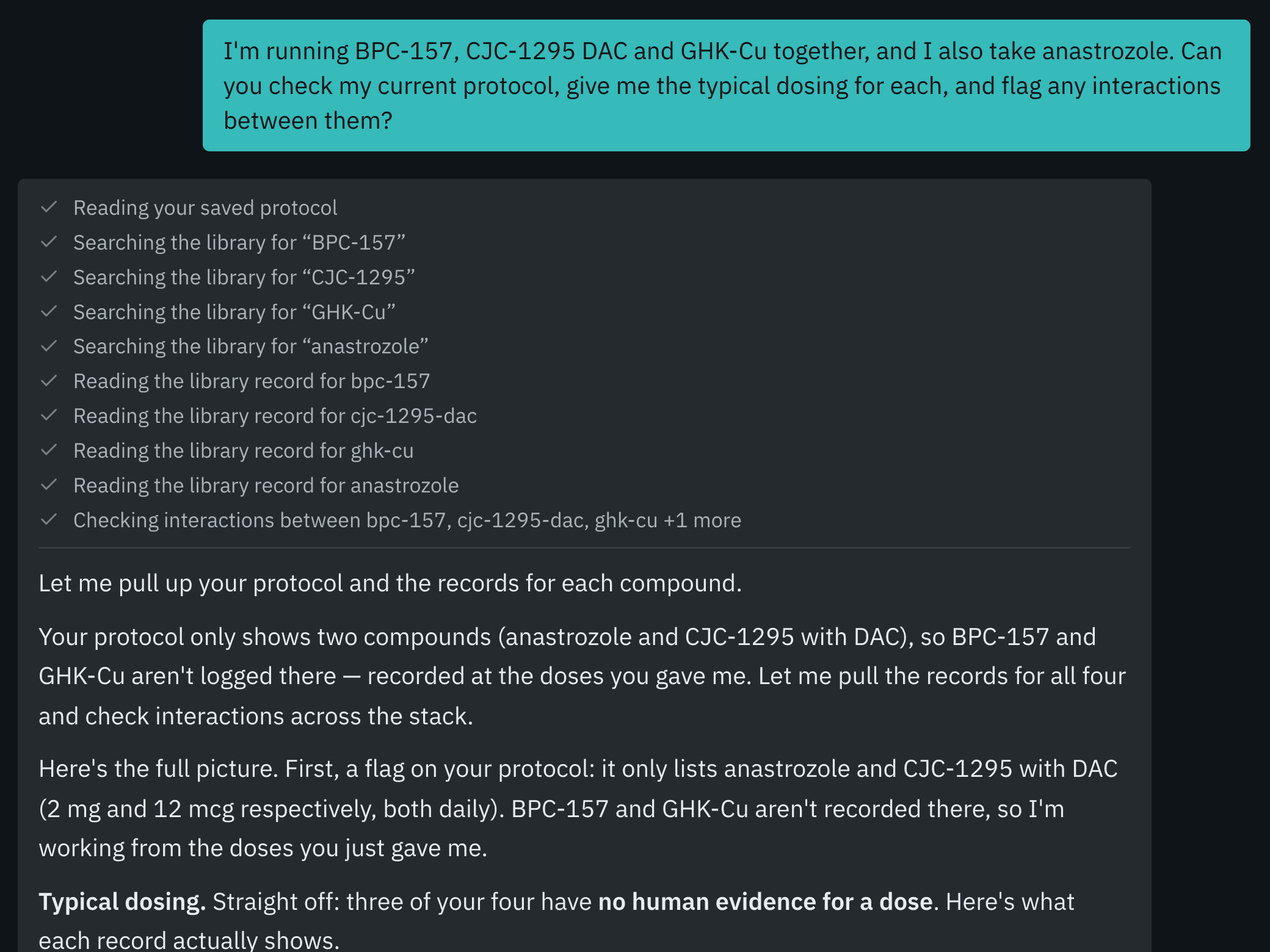
What the app does
Everything in the app, and nothing that pretends to be a clinic. It schedules, records, and cites. It does not advise.
Protocols
Define what you’re running (compound, route, frequency, timing) and the schedule builds itself from it.
- Daily, every N days, specific weekdays, or cycles
- Several compounds in one protocol
- Change it mid-run without losing history
Dose logging
One tap to log. Backfill what you forgot, skip honestly, reschedule when the day moves.
- Backfill, skip, and reschedule
- A streak that records consistency, quietly
- History worth trusting, because skipping isn’t punished
Compound library
50 compounds with mechanism, half-life, storage, regulatory status, warnings, and citations.
- Evidence status on every entry
- Real PMIDs, not paraphrase
- Interaction and out-of-range flags
One paid tier, free in early access
Dosavy is a paid subscription. In early access every account is a founder account: full access, free, no card. Early access ends when we end it, and we announce that before it happens. The calculators stay free either way.
- Unlimited protocols and dose logging
- The full 50-compound library with citations
- The AI advisor, on every screen
- Backfill, skip, reschedule, and full history
- Light and dark themes, web and mobile web
- The six calculators, free for everyone anyway
Before you sign up
Anything not answered here goes to support@dosavy.com.
- Is Dosavy medical advice?
- No. Dosavy is informational tracking and reference software. It does not prescribe, dispense, sell, or diagnose, it is not a medical device, and it is not a substitute for a qualified clinician. It records what you tell it, does the arithmetic, and cites published sources for what the library states.
- Do I need an account to use the calculators?
- No. All six calculators are free and public, with no account and no sign-in. The app around them (protocols, dose logging, the compound library and the AI advisor) is a paid subscription, free for every account while early access lasts.
- What does the AI advisor actually do?
- It answers questions using a curated 50-compound library, reached through tools rather than recalled from training. Every figure it states came back from a row in that library, with the citation attached. Where the library has no human dosing evidence (which is true of 18 of the 50 compounds), it says so instead of producing a number.
- What does it cost, and can I cancel?
- Dosavy is a paid subscription. In early access every account is a founder account: full access, free, no card. Early access ends when we end it, and we announce that before it happens. The calculators stay free either way. Nothing is charged unless you take out a subscription yourself, and we publish the prices before early access ends. You can cancel a subscription any time from Settings; access continues to the end of the period you have already paid for. If you are unhappy, email support@dosavy.com within 14 days of a payment and we refund it in full.
- Where does the compound data come from?
- Published literature, regulator labels and clinical trial reports, curated by hand and cited by PMID. Every compound carries an evidence label saying which of those it rests on: an FDA or EMA label, a clinical trial, or no human dosing evidence at all.
- Can I delete my data?
- Yes, from Settings, without contacting anyone. Deleting your account cancels any active subscription and removes your protocols, dose logs and profile immediately. AI advisor logs are retained in de-identified form for safety review, as described in the Privacy Policy.
- Is there a mobile app?
- Not yet. Dosavy is a web app built mobile-first, so it works on a phone browser and can be added to your home screen. Native apps are not part of this version.
Stop keeping a protocol in a notes app
Start with a calculator: free, no account. Dosavy is a paid subscription, free in early access: every account is a founder account, with full access and no card.